
Warning Signs of a Failing Sewer Line (and What to Do About Each One)
A failing sewer line rarely fails all at once. It sends signals first: slow drains, gurgling, a smell, a damp spot in the yard. Catching them early is usually the difference between a cleaning and a dig-up.
The signs, and what they usually mean
| Sign | What it often points to |
|---|---|
| Several drains slow at the same time | Blockage in the main line, not one fixture |
| Gurgling toilet or drain when another fixture runs | Air being pushed through a partial blockage |
| The same backup keeps returning | Roots, a belly or a cracked pipe that cleaning cannot fix |
| Water rises in a tub, shower or floor drain when you flush or run the washer | The main line is backing up to the lowest opening |
| Sewer smell that comes back | A leak, a broken joint or standing waste in the line |
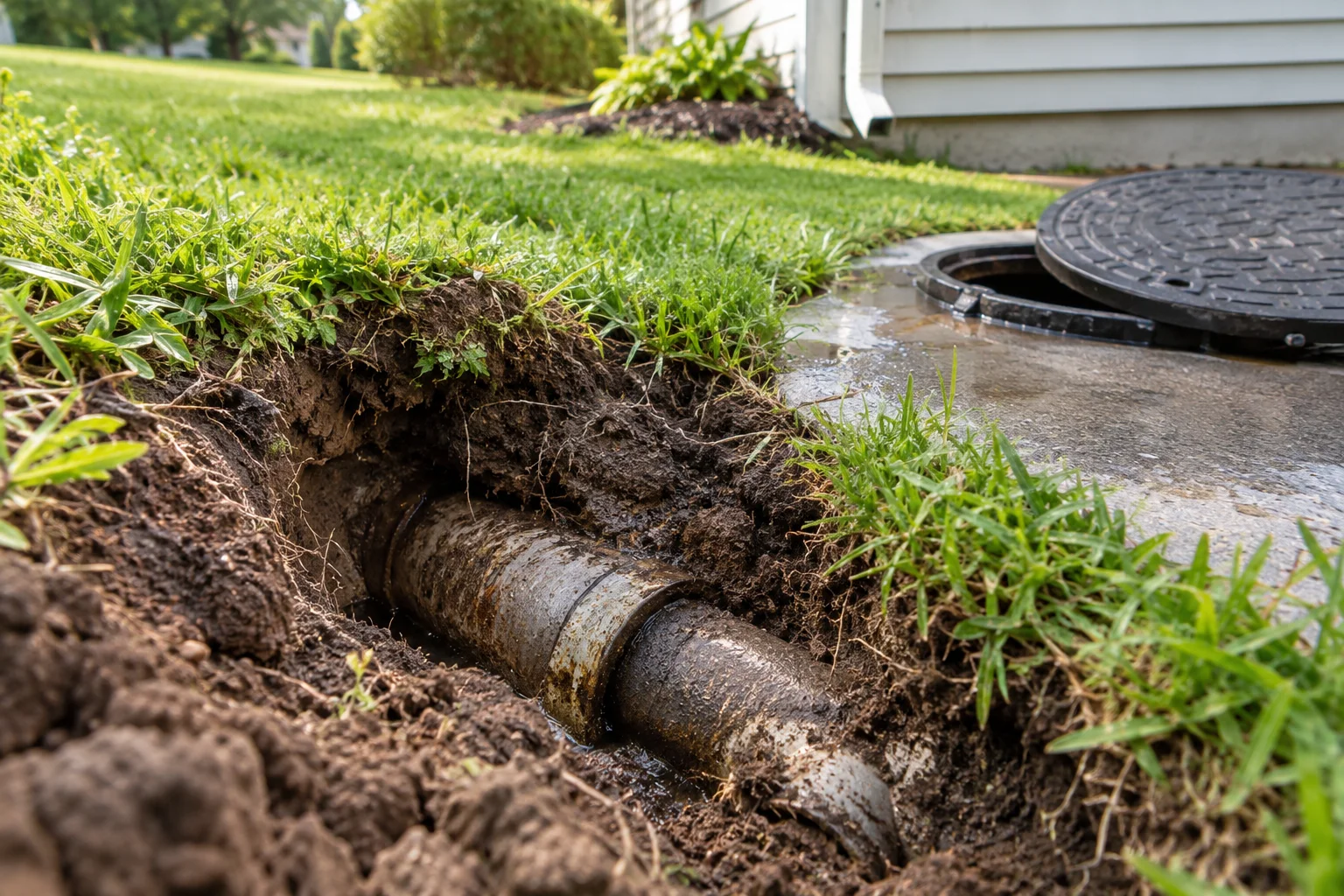
| Soft ground, sinkhole or very green strip in the yard | A leak or collapse near the line |
One slow sink is usually just that sink. Two or more problems at once, or the same problem coming back, is the line.
Why sewer lines fail
- Roots. They enter at joints looking for water and grow into dense masses. See roots in your sewer line.
- Age and material. Cast iron scales and flakes. Clay joints separate. Orangeburg, a fiber pipe used decades ago, softens and collapses.
- Settling. Soil moves and leaves a low spot, called a belly, that holds waste. See belly in sewer line.
- Blockages and collapse. Grease, wipes and debris pile up where the pipe is already damaged.
Is it a clog or the sewer line?
Try this: if only one fixture is slow, it is probably a local clog. If the lowest drain in the house, usually a basement floor drain or shower, backs up while you flush upstairs, the problem is in the main line. When you are not sure, call before it backs up into the house. For more on repeating clogs, see main sewer line keeps clogging.
How we confirm it
We run a camera through the line. A sewer camera inspection shows the pipe on video, and the fee is rolled into the repair if you hire us to do the work. You see the footage and we mark where the problem sits and how deep it is.
What happens after
- Clog or buildup: jetting clears it. A mini jetter handles sink and other small lines, and a hydro jetter handles the main sewer line. We tell you the price before we start.
- Scaled cast iron: descaling can clear scale without digging.
- Cracked or damaged section: a trenchless liner fixes a damaged section without digging, or a spot repair is quoted by the job.
- Collapse or widespread damage: replacement.
When to act
Call the same day if sewage is coming up in the house, if you have more than one slow drain, or if a backup has happened twice. Waiting turns a cleaning into a repair, and a repair into a dig-up.
Common questions
Can slow drains mean a sewer line problem? Yes, when more than one drain is slow or the slowness keeps returning after cleaning.
Can roots damage a sewer line? Yes. They enter through small gaps and keep growing, which is why cleaning alone is often temporary.
What does it cost to fix? It ranges from a few hundred dollars for jetting to thousands for a liner or replacement. See sewer line repair cost.
Call Acme Sewer & Drain Cleaning at (801) 930-8000.