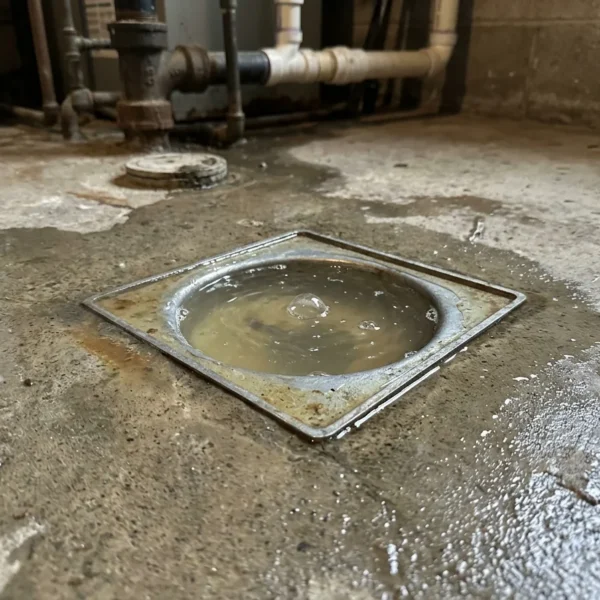
An older cast iron sewer pipe does not automatically need replacement. If the pipe still has enough structural integrity and the main problem is heavy rust, scale, or buildup, professional cleaning or descaling may restore useful flow. If a camera shows severe cracking, missing sections, major deformation, repeated failures, or advanced deterioration, repair or replacement may make more sense.
That distinction is the key for homeowners with older drainage systems. The goal is not simply to ask how old the pipe is. It is to find out what condition it is in now. This guide explains how cast iron deteriorates, what a sewer camera can show, when cast iron pipe descaling may help, and when cleaning an aging pipe may no longer be the best investment.
Why Do Cast Iron Sewer Pipes Develop Problems?
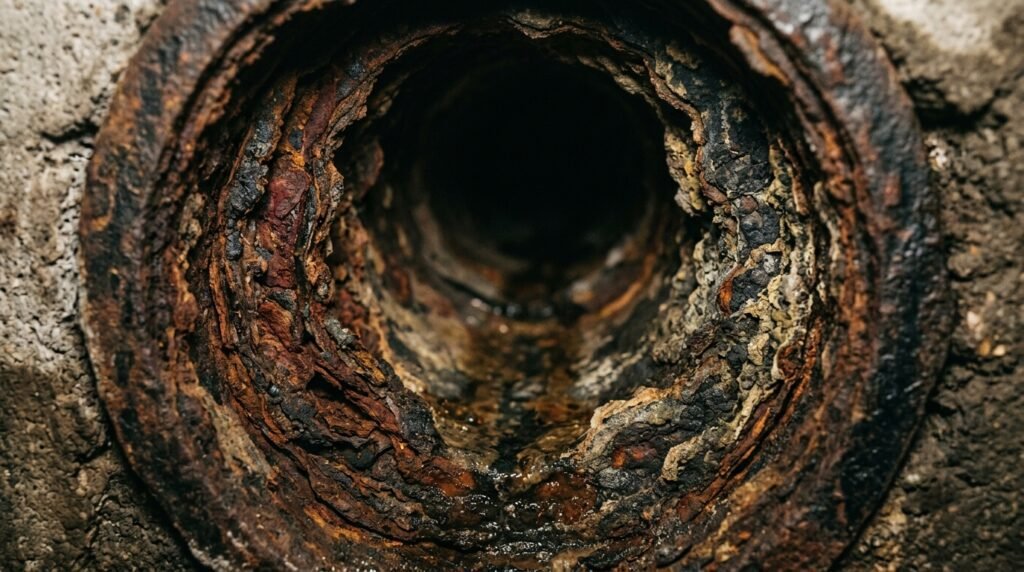
Cast iron is strong, but it does not stay unchanged forever. In a drain or sewer system, the inside of the pipe is repeatedly exposed to wastewater, moisture, waste, cleaning products, grease, and other materials. Over time, corrosion can leave the interior rough instead of relatively smooth.
That rough surface matters because waste can catch on it more easily. Rust products and hardened deposits can build outward from the pipe wall, reducing the space available for wastewater. The result may be slower drainage even when there is no single object completely blocking the line.
This is one of the most common cast iron sewer pipe problems homeowners notice: the pipe can technically remain open while its usable inside diameter becomes smaller and rougher.
What Does Cast Iron Pipe Corrosion Do to the Inside of a Sewer?
Cast iron pipe corrosion can create pitting, rust buildup, flakes, and uneven areas along the pipe wall. As the surface becomes rougher, toilet paper, grease, solids, and other material have more places to catch.
In some iron piping, corrosion products can form hard, raised deposits often described as tuberculation. EPA research into cast iron pipe condition notes that heavy tuberculation can reduce flow capacity and can even hide defects in the pipe wall during visual inspection.
For a residential sewer, that creates two separate questions. First, is buildup restricting wastewater flow? Second, what condition is the metal underneath that buildup? Removing deposits can improve the first problem, but the second question needs to be considered before aggressive cleaning begins.
What Are the Warning Signs of Cast Iron Sewer Pipe Problems?
The symptoms often develop slowly. A homeowner may first notice that a basement drain, toilet, shower, or other fixture takes longer to empty. The drain gets cleaned, works better, and then begins slowing again.
Recurring clogs are another clue. If a snake repeatedly opens the pipe but the blockage comes back, material may be catching on rough scale left behind inside the line. Gurgling, sewer odors, backups at low fixtures, and several slow drains at once can also point toward a restriction farther down the drainage system.
None of these symptoms proves that an old cast iron drain pipe is failing. Roots, grease, a sewer belly, foreign objects, or another damaged pipe material can create similar problems. That is why diagnosis matters before deciding to descale or replace anything.
How Does Scale Reduce Flow Inside Cast Iron Pipe?
Think of a sewer pipe as a passageway. Wastewater needs enough open space to carry solids through the line. When rust and hardened material build on the walls, that passage becomes tighter and less smooth.
The problem is not only the smaller opening. A rough wall catches debris much more easily than a clean pipe interior. Waste begins collecting on the high points. More material catches on that waste, and a restriction slowly develops.
ACME’s Salt Lake City descaling service describes this same pattern: scale and rough deposits can narrow drain and sewer lines and contribute to repeat clogs. Its process may include inspection, mechanical removal of hardened deposits, and high-pressure flushing when appropriate.
That is why opening one pathway with a drain snake may not solve a heavily scaled cast iron sewer line.
How Can a Sewer Camera Help Evaluate Cast Iron Pipe?
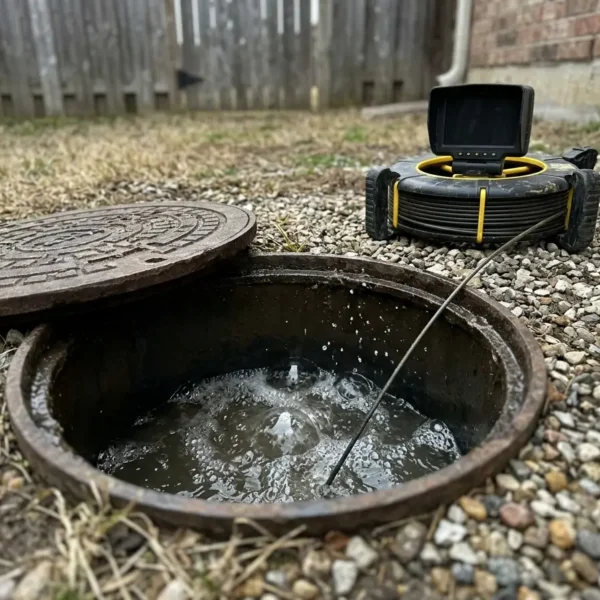
A sewer camera gives the technician a direct visual look inside an accessible section of pipe. It can reveal heavy buildup, rough walls, visible cracks, roots, standing water, damaged joints, obvious breaks, and areas where the opening has become restricted.
The camera is especially useful after the line has been cleared enough to see the pipe. If dirty water or debris covers the lens, important defects can be hidden. In some cases, removing heavy buildup may reveal portions of the pipe that were not visible during the first inspection.
There is also an important limit. CCTV is a visual tool. It cannot by itself tell you the exact amount of metal remaining through the full pipe wall. EPA research on cast iron condition assessment notes that visual inspection can identify certain internal defects, while other testing is needed when precise wall-loss information is required.
For a homeowner, that means camera findings should be interpreted as part of the overall condition assessment, not reduced to one screenshot.
When Can Cast Iron Pipe Descaling Make Sense?
Cast iron pipe descaling makes the most sense when buildup is restricting flow but the pipe appears suitable for cleaning.
Mechanical descaling uses specialized equipment to break hardened material away from the pipe interior. Depending on pipe condition and the type of buildup, flushing or hydro jetting may then help carry loosened debris out of the line. ACME lists descaling, scale and rust removal, and pipe restoration among its sewer and drain services.
The important part is the condition check before and during the work. An older pipe with thick deposits should not be treated as though it were new pipe. The technician needs to consider visible corrosion, cracks, weak areas, access, and the amount of material that must be removed.
When the pipe is a good candidate, professional cast iron pipe descaling can address buildup instead of jumping straight to full replacement.
Is Descaling the Same as Hydro Jetting?
No. The two services can work together, but they do different jobs.
Hydro jetting uses high-pressure water to wash material from inside a drainage line. It can be useful for grease, sludge, debris, roots in appropriate situations, and some types of buildup. Mechanical descaling uses tools designed to physically break or remove harder deposits attached to a pipe wall.
A heavily scaled cast iron sewer line may require more than water pressure alone. ACME’s existing descaling process describes mechanical removal followed by deeper flushing when appropriate.
The method should still be adjusted to the pipe. A technician should not choose maximum cleaning force simply because a tool is capable of it. The condition of the cast iron should guide the approach.
Can Descaling Save Every Old Cast Iron Pipe?
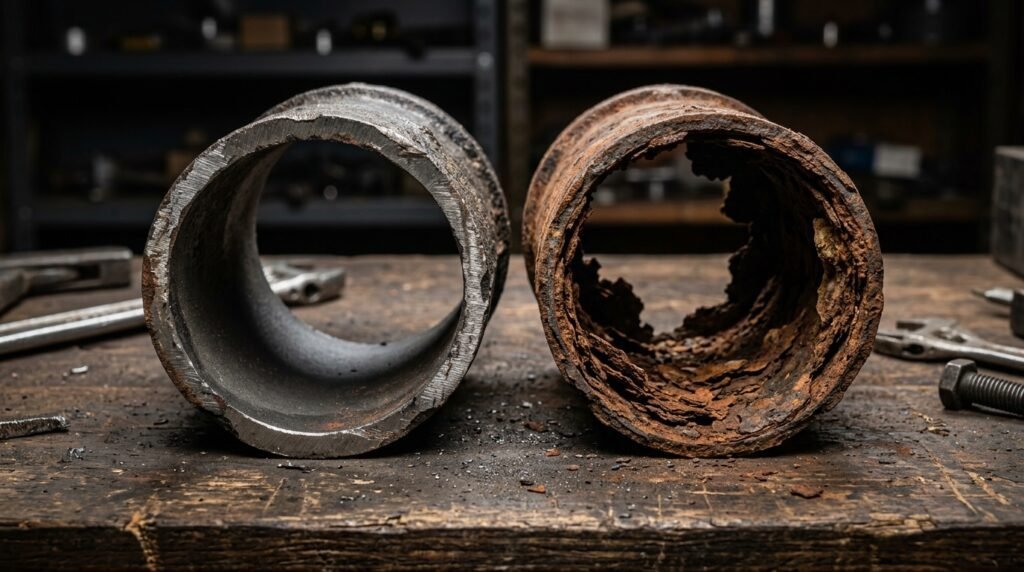
No. Descaling removes buildup. It does not rebuild missing metal or repair a major structural failure.
Imagine a pipe with a thick layer of scale but walls that remain largely intact. Removing the restriction may improve wastewater flow without replacing that section. Now imagine another pipe with major cracks, holes, badly deteriorated sections, or areas that are no longer structurally dependable. Cleaning the inside does not correct those defects.
This is where descaling cast iron pipe must be treated as restoration, not a cure for every type of deterioration.
Heavy buildup can also hide defects underneath it. That is one reason a post-cleaning camera inspection can be useful. The pipe may look different after deposits are removed, giving the technician a clearer view of cracks, pitting, joints, and other visible conditions.
What Camera Findings May Point Toward Repair Instead?
Repair becomes a stronger consideration when the problem is structural rather than mainly buildup.
Visible cracks that extend through the pipe, broken sections, severe joint movement, repeated root entry through damaged areas, major deformation, holes, or sections that no longer maintain proper alignment deserve more attention than surface rust alone. A pipe may also have several different problems at once.
One short damaged section does not always require replacing the entire line. A targeted repair may be possible when most of the system is still serviceable. If significant deterioration extends through a long run, however, comparing repair with cast iron sewer replacement becomes more reasonable.
The goal is to avoid both extremes: replacing usable pipe simply because it is old, or repeatedly cleaning a pipe that has clearly reached a structural failure point.
How Long Does Cast Iron Sewer Pipe Last?
There is no single cast iron pipe lifespan that accurately predicts when every residential sewer will fail. Age can tell you that closer inspection is sensible, but it cannot tell you the condition of one specific pipe.
Installation quality, moisture, surrounding soil, drainage use, pipe thickness, previous repairs, corrosion, ground movement, and the environment around the line can all affect how a pipe ages. Two cast iron systems installed around the same period can therefore be in very different condition today.
For the same reason, homeowners should be careful with websites that present one exact cast iron sewer line lifespan as an automatic replacement date. Condition is more useful than the calendar.
If an older line drains well and inspection does not show serious defects, age alone is not proof that it must be removed. If the pipe has repeated failures and widespread structural deterioration, age becomes part of a much bigger picture.
Why Does This Matter in Older Salt Lake City Homes?
Salt Lake City has many established residential areas, so older drainage systems are a practical concern rather than an abstract one. The city describes The Avenues as containing domestic architecture from the late nineteenth and early twentieth centuries, while Capitol Hill is identified as the city’s oldest surviving residential area. Liberty Wells includes many homes built from the late 1800s through the 1920s, and much of Yalecrest developed during the first half of the twentieth century.
That does not mean every historic property still has its original drainage piping or that every old home contains cast iron. Plumbing systems are changed, repaired, and partially replaced over time. A house may even contain several pipe materials.
For owners of older Salt Lake City homes, the practical approach is to identify the pipe material first and inspect its condition instead of making assumptions based only on the construction date.
ACME serves homes throughout its Salt Lake City service area as well as surrounding Wasatch Front communities. Its current services include sewer cleaning, video inspection, descaling, scale and rust removal, and sewer repair.
When Does Replacement Make More Sense Than Restoration?
Cast iron sewer replacement becomes more worth considering when cleaning can no longer address the main problem.
If most of the trouble comes from deposits inside a structurally usable pipe, restoration may be the less disruptive first option. If there are several failing sections, severe deterioration, repeated breaks, extensive cracking, or other structural defects, spending money on repeated cleaning may provide poor value.
The decision should also consider how much of the system is affected. Replacing a whole run because of one repairable defect may be unnecessary. Repeatedly repairing several weak areas in a broadly deteriorated system may be equally inefficient.
This is why the best sequence is usually inspection first, cleaning or descaling when appropriate, another look at the exposed pipe condition, and then a repair-versus-replacement decision based on what remains.
For a closer look at the cleaning side of that decision, ACME’s related guide to cast iron pipe descaling explains the equipment and process used to remove heavy internal buildup.
Frequently Asked Questions About Cast Iron Sewer Pipes
Does an old cast iron sewer pipe always need replacement?
No. An old cast iron drain pipe may still be usable if its structure remains sound and the main problem is removable buildup. Age should prompt inspection, not an automatic replacement decision.
Can cast iron pipe corrosion be removed?
Buildup caused by cast iron pipe corrosion can often be cleaned from the interior surface, but cleaning does not replace metal that has already been lost. The pipe should be evaluated for structural damage before aggressive descaling is performed.
Is cast iron pipe descaling safe?
It can be appropriate when the pipe is in suitable condition and the equipment is matched to that condition. Heavily damaged or fragile pipe may require a different approach, which is why inspection is important before deciding how to clean it.
Can a sewer camera tell if cast iron needs replacement?
A camera can show visible deterioration, cracks, buildup, roots, standing water, joint problems, and other defects. It cannot provide a complete measurement of pipe-wall strength by itself. The decision should consider the full inspection and the history of the line.
Can hydro jetting fix cast iron pipe corrosion?
Hydro jetting can clean debris and buildup from an appropriate pipe, but it does not reverse corrosion or rebuild lost metal. If cast iron drain pipe corrosion has caused structural failure, repair or replacement may be needed.
Should I descale or replace my cast iron sewer line?
If buildup is the main restriction and the pipe appears structurally serviceable, descaling may be worth considering. If inspection shows severe structural deterioration across the line, repair or replacement may provide better long-term value.
What are the clearest signs that cast iron is deteriorating?
Repeated blockages, slow drainage, heavy scale seen on camera, visible cracks, rough or flaking surfaces, and repeated problems in the same section can justify a closer condition assessment. No single symptom confirms replacement by itself.
Find Out What Condition Your Cast Iron Pipe Is Actually In
A cast iron sewer pipe should not be replaced simply because it is old, and it should not be repeatedly cleaned when serious structural damage is already visible. The right decision comes from separating removable buildup from deterioration that has weakened or damaged the pipe.
ACME Sewer & Drain Cleaning works with older drain and sewer systems throughout Salt Lake City and the Wasatch Front. Camera inspection, cleaning, descaling, and sewer repair can be used as different steps depending on what the pipe actually needs. ACME currently lists video inspection, descaling, scale and rust removal, hydro jetting, and sewer-main services among its specialties.
If you have recurring clogs, heavy scale on a camera inspection, or concerns about cast iron sewer pipe problems, contact ACME Sewer & Drain Cleaning or call (801) 930-8000 to have the line evaluated before deciding between restoration, repair, and replacement.