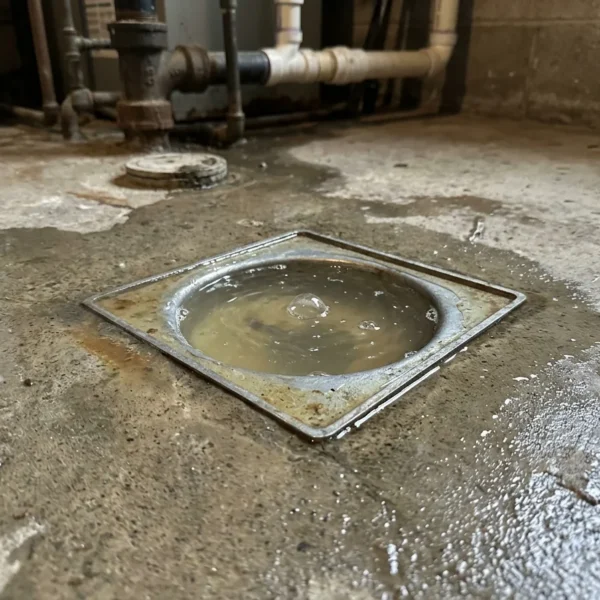
If you are wondering how long does a sewer line last, the answer depends heavily on the pipe material, installation, soil support, joints, corrosion, roots, and current structural condition. Some sewer materials can remain useful for many decades, while others have known failure problems much earlier. Age is a warning sign, not an automatic replacement date.
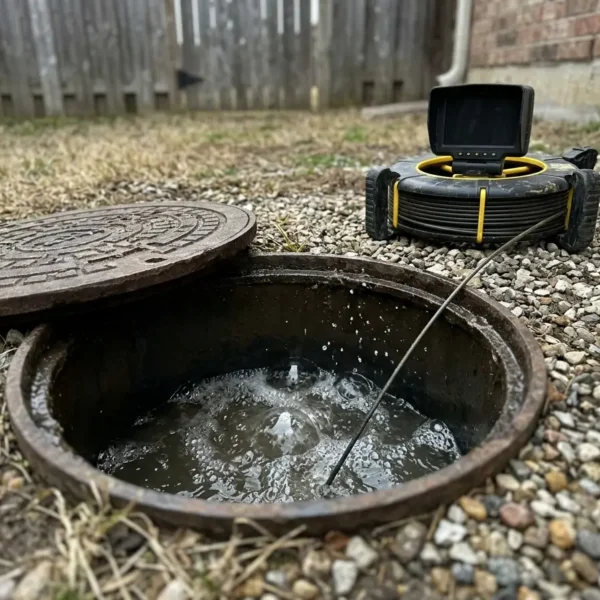
The better question is how much useful life your specific sewer line has left. A camera inspection can show cracks, roots, corrosion, separated joints, standing water, deformation, and other defects that tell you more than the home’s construction year alone. EPA guidance uses condition assessment for this same reason: inspection data helps estimate remaining useful life and guide maintenance, rehabilitation, or replacement decisions.
Sewer Line Lifespan Depends on More Than Age
A sewer line lifespan should never be treated like the expiration date printed on food. Two sewer pipes made from the same material and installed in the same decade can age very differently.
Pipe material matters, but so do the conditions around it. Soil type and stability, moisture, bedding, installation quality, joint design, wastewater conditions, ground movement, and loading above the line can all affect performance. EPA guidance specifically notes that soil structure, stability, moisture, pipe support, corrosion resistance, and installation conditions are important considerations for underground sewer piping.
That is why a 70-year-old pipe may still be functioning while another line of similar age has already needed major repair.
For homeowners, age is best used as a reason to inspect an old sewer line, not as proof that it needs to be removed.
How Long Does Cast Iron Sewer Pipe Last?
The cast iron sewer lifespan varies widely because corrosion plays such a large role in how the material ages.
Cast iron is strong, but wastewater and surrounding conditions can slowly attack the metal. Inside the pipe, corrosion can create rough walls, pitting, rust buildup, and scale. That rough surface can reduce the usable pipe opening and make it easier for waste to collect.
EPA research identifies internal corrosion, external pitting, breaks, joint failure, leakage, and longitudinal splitting as potential defects in cast iron and ductile iron systems.
EPA sewer asset modeling provides a useful example of why lifespan figures should be treated cautiously. One Seattle Public Utilities model used an 80-year total-life assumption for cast iron sewer assets. That is a planning model for a utility system, however, not a promise that every residential cast iron lateral lasts exactly 80 years.
The real cast iron pipe lifespan at your home depends more on what the pipe looks like today. Heavy internal scale may sometimes be cleaned or descaled if the remaining pipe is structurally suitable. Deep corrosion, holes, major cracks, or widespread failure can push the decision toward repair or replacement.
For more detail on what can and cannot be restored, see ACME’s related guide to sewer camera inspection.
How Long Does Clay Sewer Pipe Last?
A clay sewer pipe lifespan can be surprisingly long when the pipe was installed well and has not been disturbed.
Vitrified clay is highly resistant to many chemicals found in wastewater. EPA guidance notes that the material is strong and resistant to chemical corrosion, abrasion, and external chemical attack. The weak points are often not the clay itself but the joints, alignment, or damage caused by outside forces.
EPA guidance on gravity sewer defects lists cracking, broken sections, root intrusion, grease buildup, and joint misalignment or leakage among the main concerns for vitrified clay systems.
A Seattle Public Utilities asset model cited by EPA used a 120-year total-life assumption for vitrified clay sewer assets. Again, that is a utility planning figure rather than a replacement rule for residential laterals.
An older clay line may therefore remain functional for a long time while still having vulnerable joints. Roots can enter where a joint has opened. Soil movement can shift sections out of alignment. A crack can catch waste and eventually lead to a larger failure.
So the age of clay pipe is only one part of the decision. Camera findings matter more.
What Is the Orangeburg Pipe Lifespan?
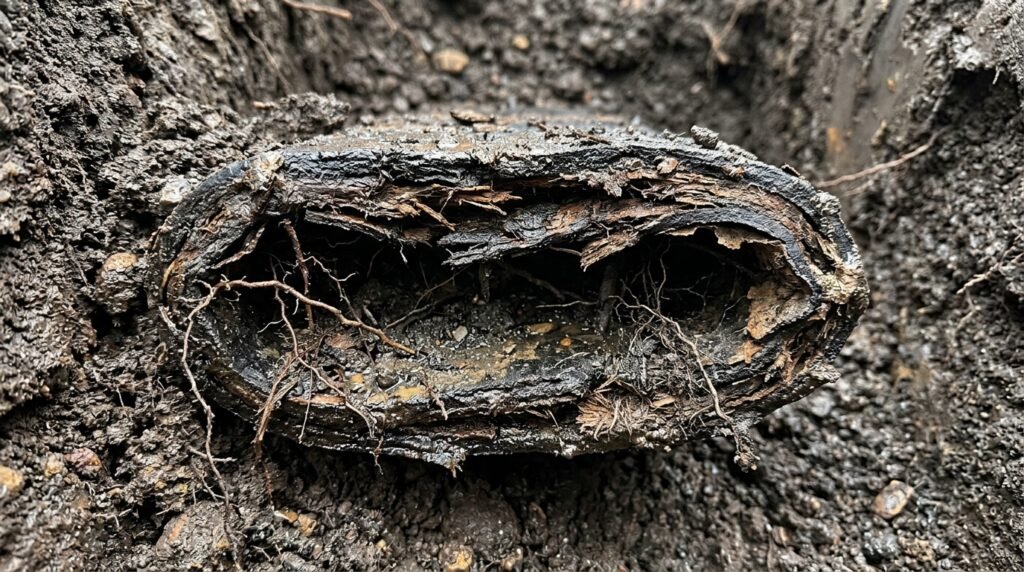
Orangeburg pipe lifespan is a bigger concern because the material has a history of structural failure.
Orangeburg, also called bituminous fiber pipe, was made differently from clay, iron, or modern plastic sewer pipe. EPA wastewater research describes Orangeburg as one of the older sewer-lateral materials that is no longer installed and notes that some older lateral materials, including Orangeburg, have experienced widespread failure.
Unlike cast iron, where scale can sometimes be removed from an otherwise usable wall, an aging fiber pipe can deform or lose structural strength. Cleaning does not restore a pipe that is flattening or collapsing.
For that reason, finding Orangeburg during an inspection deserves more attention than simply knowing that another sewer line is old.
If the camera shows the line holding its shape and continuing to flow, the exact next step depends on its condition and the homeowner’s risk tolerance. If it shows deformation, cracks, collapse, heavy root entry, or severe restriction, replacement becomes a much stronger discussion.
The important point is that the material itself raises the level of concern. An Orangeburg line should not be assumed healthy simply because sewage is still moving through it today.
How Long Does PVC Sewer Pipe Last?
The PVC sewer pipe lifespan is generally much longer than the service history of many older residential sewer materials when the pipe is correctly designed, installed, and supported.
PVC does not rust like cast iron. It also has a smooth interior, which reduces friction and gives waste fewer rough surfaces to catch on. EPA guidance describes thermoplastic sewer materials such as PVC and ABS as corrosion resistant, smooth, lightweight, and flexible.
The Plastics Pipe Institute states that properly designed, installed, and operated plastic piping can have a service life exceeding 100 years. An EPA report describing Seattle’s sewer asset model also used 100 years as its modeled total life for PVC sewer pipe. Those figures are useful planning references rather than guarantees for an individual home’s lateral.
PVC can still fail. EPA identifies excessive deflection, joint misalignment, leaks, grade problems, and alignment issues among potential defects in gravity sewer systems using PVC.
A poorly bedded PVC line can move or sag. A joint can separate. Construction activity can damage a section. Roots may take advantage of a failed connection.
So even a material with a long expected service life needs proper installation.
What About ABS Sewer Pipe?
ABS is another thermoplastic material found in drainage systems. Like PVC, it does not experience rust corrosion in the same way as iron pipe.
EPA groups ABS with PVC and other thermoplastics when describing sewer materials. These plastics offer smooth interiors and good corrosion resistance, although proper bedding and installation remain important.
There is less value in giving homeowners one exact sewer pipe lifespan for ABS because pipe formulation, application, installation, and site conditions can differ. If an ABS sewer lateral is draining properly and the camera shows good joints, alignment, and pipe shape, age alone is not a reason to replace it.
If the line shows deformation, damaged connections, bad slope, or repeated structural problems, those findings matter more than a generic lifespan number.
Which Sewer Pipe Material Lasts the Longest?
There is no single winner under every condition.
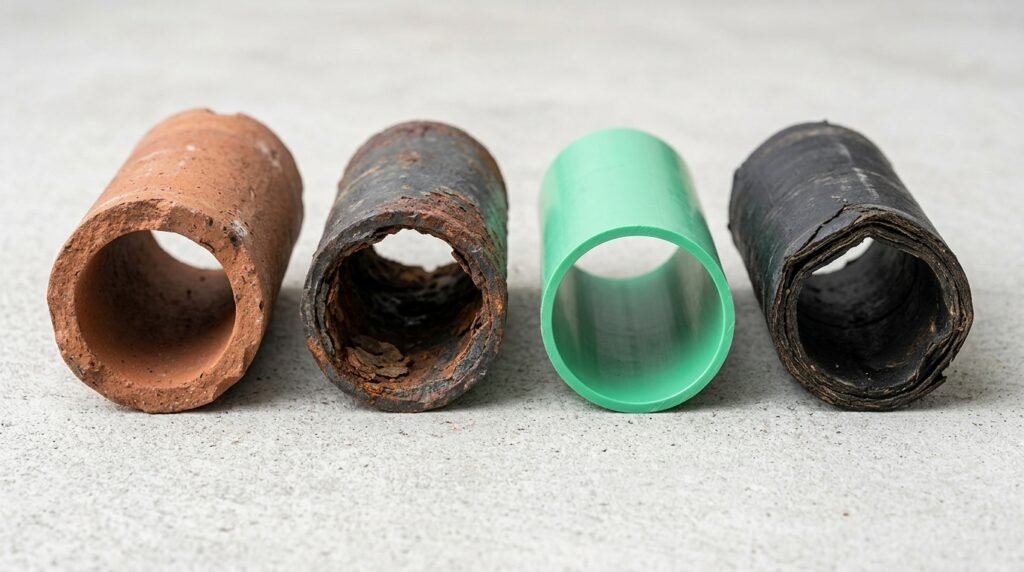
Modern plastic has strong resistance to corrosion and a potentially very long service life when installed correctly. Vitrified clay can also remain serviceable for a very long time because the material itself handles chemical exposure well. Cast iron offers strength but faces corrosion. Orangeburg has a much less favorable structural history.
A simple way to think about the materials is:
| Pipe material | General aging concern | What matters most during inspection |
| Cast iron | Corrosion and internal buildup | Scale, pitting, cracks and wall condition |
| Clay | Brittle sections and joints | Roots, cracks, offsets and joint separation |
| Orangeburg | Deformation and structural decline | Flattening, collapse, roots and restriction |
| PVC | Installation and alignment | Deflection, joints, grade and physical damage |
| ABS | Installation and connections | Shape, slope, joint condition and damage |
These are risk patterns, not guaranteed failure schedules. EPA’s own wastewater guidance shows that different materials have different common defect types, which is why inspection should focus on the problems most likely for the material in the ground.
What Can Shorten a Sewer Line’s Life?
Several conditions can shorten the useful life of an underground sewer regardless of material.
Tree roots are one example. Roots generally become a sewer problem when they find an opening at a crack, damaged connection, or joint. Once inside, they can restrict flow and place more stress on an already weak area.
Ground or soil movement can also affect pipe alignment. Even a material that resists corrosion can perform badly if part of the line settles and creates a low spot. EPA sewer design guidance stresses that the surrounding soil provides important support, especially for flexible pipe.
Other concerns include repeated heavy blockages, damaged joints, poor installation, corrosion, pipe deformation, and physical damage from later excavation or construction.
The pattern of service calls matters too. A line that requires cleaning again and again may be telling you more than its age does.
How Do You Know When to Replace a Sewer Line?
Knowing when to replace sewer line piping should start with structural condition, not just a birthday.
One isolated root problem does not automatically mean the entire lateral should be replaced. A section of scale in cast iron may be suitable for cleaning. One damaged joint may allow a targeted repair.
Replacement deserves more serious consideration when inspection shows widespread structural deterioration, several failing sections, major deformation, collapse, extensive cracking, severe offsets, or continuing problems throughout the line.
Repeated service history can also change the calculation. If the same old sewer line needs frequent cleaning or repairs and the camera shows several defects, continuing to fix one symptom at a time may become less practical.
EPA condition-assessment guidance follows the same basic logic. Inspection findings are used to estimate condition and remaining useful life, then guide maintenance, rehabilitation, further inspection, or complete replacement.
ACME provides residential sewer main cleaning and repair when inspection shows that a problem goes beyond a normal drain clog.
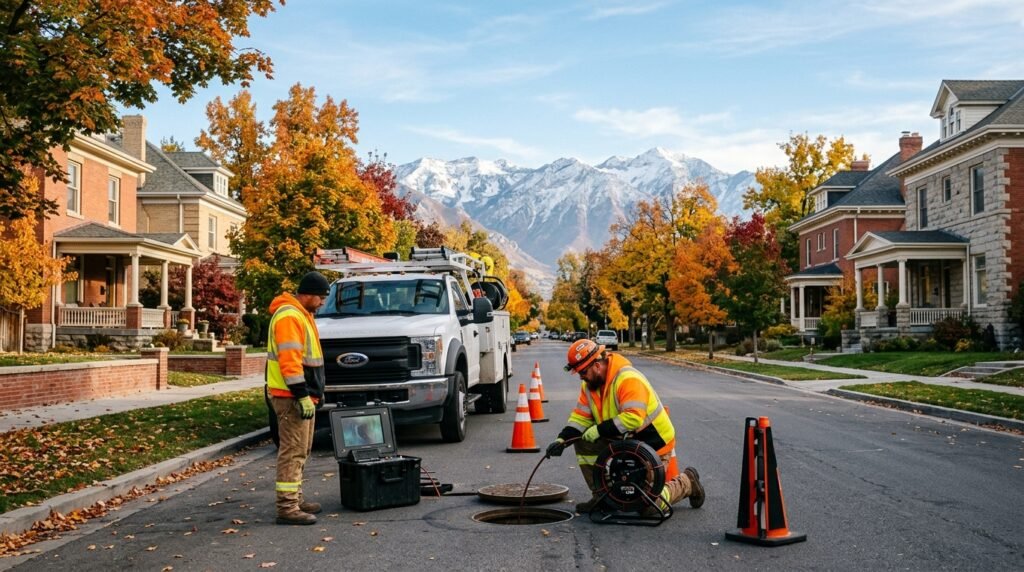
Why Sewer Age Matters in Salt Lake City and Utah
Utah homeowners should not assume their sewer lateral is the same age as the home. Lines may have been repaired or replaced during remodeling, utility work, additions, or previous sewer failures.
Still, Salt Lake City has genuinely old sewer infrastructure. The city’s Beck Street trunkline dates to the 1890s, while another major project replaced sewer infrastructure along 2100 South that had reached or passed roughly a century of service in some sections. Those are public sewer mains, not private residential laterals, but they show why age and condition are real infrastructure issues in the city.
Salt Lake City Public Utilities also provides a sewer lateral map showing public sewer lines, laterals, manholes, and available permit notes for individual addresses. That can be useful when homeowners are researching previous sewer work.
Homes elsewhere along the Wasatch Front can have very different pipe materials and installation histories. The safest approach is to identify the actual material rather than guessing from the home’s age.
For homeowners in the area, ACME’s Salt Lake City drain and sewer service page covers local sewer and drainage assistance.
Can a Sewer Camera Tell How Much Life Is Left?
A camera cannot put an exact expiration date on a sewer line, but it can give much better information than age alone.
The inspection can show visible cracks, root intrusion, corrosion, scale, joint movement, deformation, standing water, damaged sections, and other defects. EPA describes CCTV as a core condition-assessment tool for sewer systems and notes that inspection data can help estimate remaining useful life and guide rehabilitation or replacement decisions.
A camera has limits. It shows what can be seen from inside the pipe. It does not measure every part of pipe-wall strength or predict exactly when failure will occur.
Still, for a homeowner deciding whether to maintain, repair, or replace an aging sewer, seeing the condition of the pipe is far more useful than relying only on a broad lifespan chart.
Frequently Asked Questions About Sewer Line Lifespan
How long does a sewer line last?
How long does a sewer line last depends on the material and its condition. Clay and modern plastic can remain useful for many decades, while cast iron may be limited by corrosion and Orangeburg has a greater risk of structural deterioration. Inspection is a better guide than age alone.
Does a sewer line need replacement when it reaches its expected lifespan?
No. A sewer line lifespan is an estimate, not an automatic replacement date. A pipe that is older than a general benchmark may still be functioning well, while a younger line can fail because of poor installation, ground movement, roots, or damage.
How long does cast iron sewer pipe last?
The cast iron pipe lifespan varies considerably. Corrosion, scale, soil conditions, pipe-wall condition, and installation all matter. Instead of replacing cast iron based only on age, inspect it for pitting, cracking, heavy buildup, and structural damage.
Can clay sewer pipe last 100 years?
It can remain in service for a very long time under good conditions. EPA has documented utility models that assume long service lives for vitrified clay, but individual residential pipes should be judged by cracks, joints, roots, alignment, and current performance.
How long does PVC sewer pipe last underground?
The PVC sewer pipe lifespan can exceed 100 years when plastic piping is properly designed, installed, and operated, according to industry service-life research. Poor bedding, damaged joints, deflection, or ground movement can shorten actual service.
Should an Orangeburg sewer line be inspected even if it still drains?
Yes. Because Orangeburg is an older material with a documented history of deterioration and widespread failure, checking its shape and structural condition is sensible even when wastewater is still moving through the line.
When should I inspect an old sewer line?
Consider inspection when there are repeated backups, recurring roots, slow main-line drainage, unexplained sewer odors, previous repair history, or uncertainty about an older pipe’s condition. An inspection is also useful before making a major repair-or-replacement decision.
Age Is Only the Starting Point
The answer to how long does a sewer line last is different for every property. Pipe material gives you useful clues, but it does not tell the entire story. Cast iron may corrode. Clay can develop cracked or shifted joints. Orangeburg may deform. PVC and ABS can have installation or alignment problems.
What matters most is whether wastewater can move through the line and whether the pipe remains structurally dependable.
ACME Sewer & Drain Cleaning provides sewer cleaning, camera inspection, diagnostics, and repair services throughout Salt Lake City and the Wasatch Front. If you have an aging sewer, repeated backups, or concerns about its remaining service life, contact ACME Sewer & Drain Cleaning or call (801) 930-8000 to have the line evaluated before deciding whether maintenance, repair, or replacement makes sense.